

Cloud Couch Sectional vs Single Sofa: Which Fits Your Space


Cloud couch sectional arranged in an L-shape in a modern living room
A sectional is not automatically bigger than a sofa. A 90-inch 3-seat sofa takes up more usable floor than a compact L-sectional with a chaise tucked into the corner. The right pick depends on your room shape, how you actually use the couch, and whether you need flexibility. Here is the honest decision framework.
By the end of this guide, you will know which one works better for your space, your lifestyle, and your budget.
The one we would pick
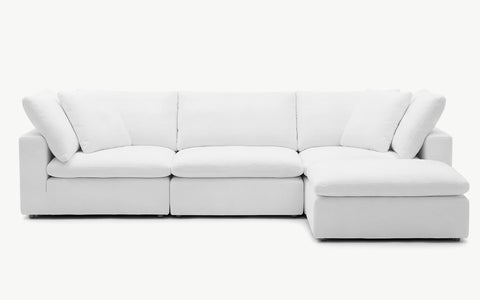
Configuration: 4-Seater Sectional


Quick Pick by Room Type
| Room | Recommended | Reason |
|---|---|---|
| Narrow living room under 11 ft wide | Single sofa | Sectionals block traffic flow |
| Square living room 13 x 13 or larger | Sectional | Corners become usable |
| Open-plan space | Sectional | Defines the living zone |
| Rental with frequent moves | Single sofa | Easier to transport |
| Family with 3+ people | Sectional | More seating per square foot |
| Home office or reading nook | Single sofa | Allows for a pair with a chair |
Why Pick a Sectional
- More seating per square foot. A 10-foot L-sectional seats 5 adults. A 10-foot single sofa seats 3 to 4.
- Corner use. The chaise or corner module turns a wasted corner into prime real estate.
- Defines a zone. In an open plan, the sectional creates a visual boundary without walls.
- Lounge-friendly. The chaise offers a place to stretch out without buying a separate ottoman.
Why Pick a Single Sofa
- Flexibility. Easier to reposition, pair with chairs, or add to a new room later.
- Works in any layout. A sofa slots into narrow rooms, floats in the middle, or backs up to a wall.
- Cheaper. A quality single sofa is $600 to $1,500 less than the equivalent sectional.
- Easier to move. One piece, not three to five.


Layout Test: Sectional vs Sofa
Use this 30-second test to decide. Draw your room to scale on paper. Mark the doors, windows, and focal points (TV, fireplace). Now:
- Place a 90-inch sofa against the longest uninterrupted wall. Can you walk around it? Is there space for a chair across from it?
- Place a 100 x 80 sectional with the chaise in the corner. Does the chaise block a door or window?
If both pass, compare traffic flow. The option that leaves a wider walking path wins.
Why owners pick Sofatica
Washable Slipcovers
100% Real Goose Down
Module Secure™ Lock
Adjustable Cushion Fill
Flexibility and Moving
Renters move every 18 to 36 months on average. A sectional has to be reassembled, carried in pieces, and often will not fit in a new floor plan. A sofa travels easier, repurposes to any room, and holds resale value better.
Homeowners planning to stay 5+ years get more value from a sectional. The upfront investment pays back in daily comfort.
Price Comparison
- Entry level: 3-seat sofa $800 to $1,400. L-sectional $1,400 to $2,400.
- Mid range: 3-seat sofa $1,400 to $2,400. L-sectional $2,400 to $4,000.
- Premium: 3-seat sofa $2,400 to $6,000. L-sectional $4,000 to $9,000.
Sectionals always cost more per unit but less per seat. For a household of 3 or more, the per-seat value of a sectional is stronger.
Common Mistakes
- Buying a sectional that blocks a walkway. Measure the clear path to every door and window before ordering.
- Buying a sofa that is too small for a big room. A 72-inch sofa in a 400 square foot room looks lost.
- Forgetting to measure the delivery path. Sectionals arrive in pieces. Single sofas arrive whole. If your hallway is narrow, the single sofa may not fit.
- Ordering the wrong chaise orientation. Right-arm-facing and left-arm-facing are from the seated perspective looking at the couch. See our cloud couch size guide for the exact chaise orientation rules.
Flexible Modular Configurations
Sofatica's modular cloud couches convert between sofa and sectional layouts as your space and life change.
Explore Modular Cloud CouchesFAQ
Is a sectional worth it for just two people?
Can you convert a sectional into a single sofa?
Do sectionals cause traffic flow problems?
What if my room is awkwardly shaped?
Built for Real Life
Every Sofatica ships free, arrives in modular pieces you can carry upstairs alone, and comes with covers you can throw in the wash.


