

How long does a feather down sofa take to break in?

A feather down sofa has no universal break-in time: the cushion construction, use, and care instructions determine how its feel changes. Initial settling is different from permanent softening, and fluffing remains part of caring for loose feather-and-down filling. Judge support and recovery rather than waiting for a promised number of days.
- Feather down sofa break in time depends on cushion construction, not a universal deadline.
- Fluffing redistributes loose filling; it does not repair damaged cushion support.
- Compare cushions after the same care routine before deciding whether one is unusually flat.
- Sofatica suits shoppers seeking machine-washable modular sofas; washability does not eliminate cushion maintenance.
The one we would pick

Configuration: 4-Seater Sectional


How long does a feather down sofa take to break in?
There is no single break-in deadline that applies to every feather down sofa. A cushion containing loose filling behaves differently from one with a supportive core beneath a feather-and-down wrap, so the filling name alone cannot tell you when the seat will reach its settled feel.
For your 2026 purchase, use the model’s written instructions as the starting point. If the seller specifies a settling period, follow that guidance for that exact sofa rather than applying it to other models. The related guide to how long a cloud couch takes to break in addresses the same question for that sofa category.
Separate these changes before deciding that your sofa needs more time:
| What you notice | What it tells you | What to do next |
|---|---|---|
| Loose filling looks fuller after fluffing | Redistributing the filling changes its shape | Follow the cushion-care instructions |
| A frequently used seat feels different from another seat | The seats have different use histories | Compare after equivalent care and normal sitting |
| A cushion remains uneven after approved care | Fluffing has not resolved the unevenness | Document it and ask the seller to assess it |
| You feel a hard edge beneath the cushion | The issue concerns support or positioning, not just appearance | Check placement and contact the seller if it persists |
A cushion becoming less pristine is not the same as a cushion becoming more comfortable. Assess both the shape you see and the support you feel.
Why this matters
Calling every change a break-in issue creates the wrong expectation. You might wait for a seat to become firmer when you actually prefer a different cushion construction, or keep flattening a cushion that needs redistribution rather than more compression.
A feather down sofa also needs a different judgment from a tightly upholstered seat. Loose filling moves under your weight, so an indentation after sitting is not enough on its own to establish a problem. What happens after the prescribed care matters more.
Use this 2026 guide to make a practical decision: keep using and caring for a comfortable sofa, correct a placement issue, or ask the seller to investigate an unresolved support concern. Do not use a generic break-in estimate as a reason to ignore discomfort or miss an applicable return deadline.
What actually changes when a cushion settles?
Loose filling changes position
Feathers and down move within the space that contains them. Your usual sitting position compresses some areas more than others, which changes the cushion’s outline and the distribution of filling beneath you.
Fluffing helps redistribute that loose filling. It is maintenance, not a way to make the cushion permanently hold its freshly dressed shape. If you want an always-tailored appearance without reshaping cushions, that preference deserves attention before you choose a loose-fill sofa.
Cushion construction determines support
The filling nearest your body is not necessarily the whole support system. Some feather-and-down cushions include a core or other internal components, and those components affect the seated feel.
Ask what is inside the exact seat cushion. A statement about down content does not, by itself, establish the construction of every cushion or describe the sofa’s underlying support. Avoid treating the words feather down as a complete specification.
Your seating position changes the experience
A deep seat can feel different when you sit upright with your feet supported than when you curl up with your legs on the sofa. Neither position tells you everything about the other.
Test the position you actually use. If your main activity is reading upright, do not judge comfort only while reclining; if you mostly stretch out, assess that position too. Waiting for break-in does not change the basic relationship between seat depth and your body.
Why feather down sofa break in time varies
The useful question is not simply how old the sofa is. It is what has happened to the cushion, and whether its construction suits the way you sit.
- Cushion construction: Loose fill, wrapped cores, and other internal arrangements do not provide identical support. Confirm the model’s construction before comparing it with another sofa.
- Use pattern: A favorite seat receives different compression from a rarely used end seat. Compare like with like rather than assuming every module should feel identical immediately.
- Filling distribution: A compressed center and fuller edges change how a cushion feels. Carry out approved fluffing before assessing an apparent low spot.
- Cushion placement: A cushion that is not properly seated on its base can feel wrong without needing additional break-in. Check alignment first.
- Care method: Follow the instructions for the cushion and its cover separately. A washable cover does not establish that the filled insert belongs in a washing machine.
For a sofa bought in 2026, keep the instructions supplied with that model. General advice cannot replace product-specific restrictions on washing, rotation, or handling.
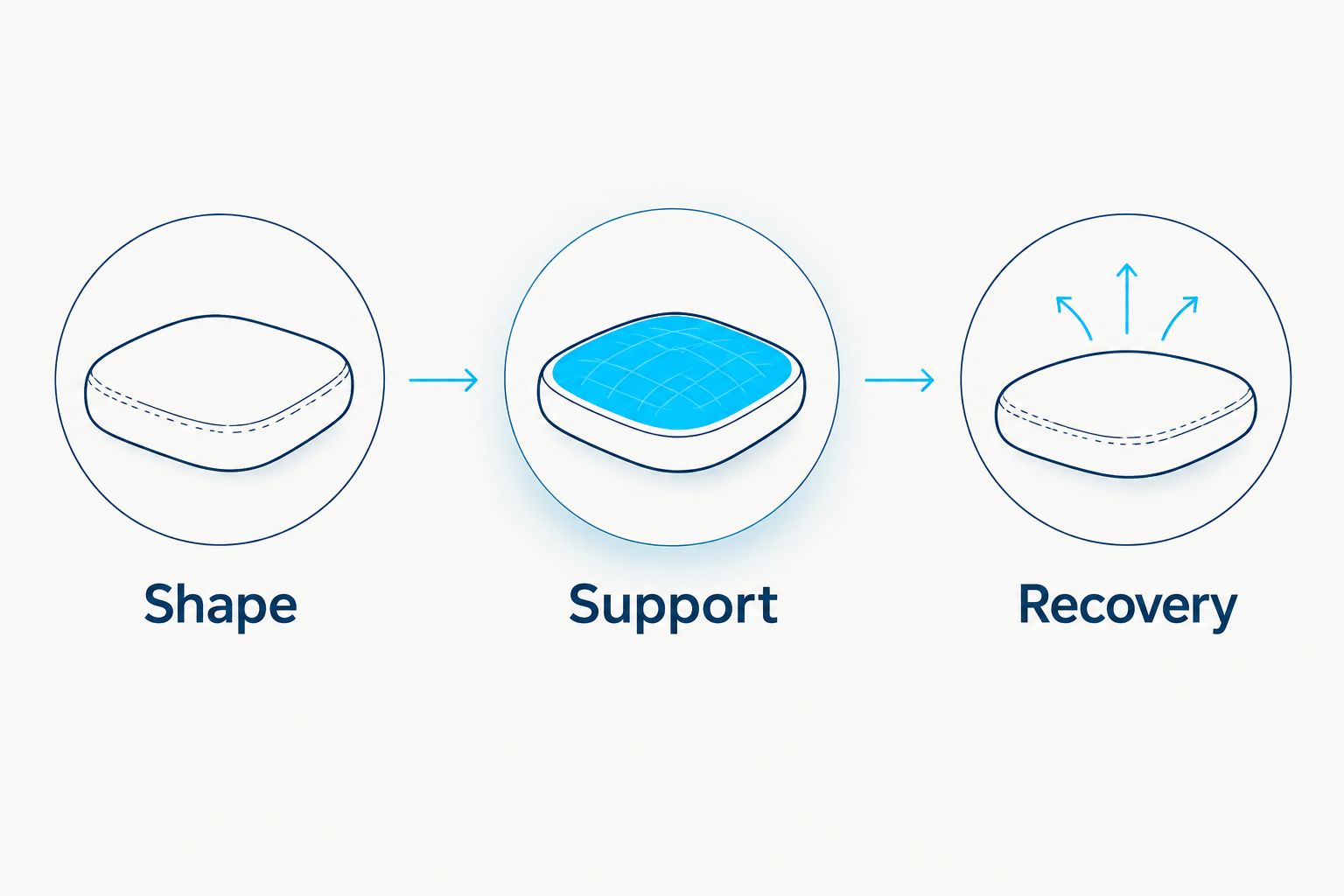
Assess your sofa with 3 checks
Before trying to speed anything up, make a simple record of what you are experiencing. These 3 checks distinguish a changing appearance from an unresolved comfort concern without assigning an unsupported deadline.
Shape
Look at the cushion before sitting and again after the care routine. Note whether the indentation improves and whether the filling appears evenly distributed across the usable seat.
Take photographs from the same angle if you need to explain the issue to the seller. A clear comparison is more useful than describing the sofa as generally less fluffy. Do not pull apart sealed components to inspect the filling.
Support
Sit in your usual position and notice what is beneath you. Check whether the cushion supports you comfortably or whether you feel a hard edge, an uneven area, or an uncomfortable dip.
Appearance and support are separate checks. A relaxed-looking cushion can still feel comfortable, while a cushion that photographs well can still be unsuitable for the way you sit. Record the sensation, not just the visible crease.
Recovery
After getting up, perform only the care steps allowed by the manufacturer. Check whether the cushion’s shape and feel improve, then compare with your earlier observation.
Do not demand that a loose-fill cushion restore itself without help if its instructions call for fluffing. Equally, do not label persistent discomfort normal just because the sofa contains feathers or down. Care instructions explain maintenance; they do not cancel a support concern.
Follow these 4 steps instead of forcing break-in
Treat this as a care-and-assessment sequence, not a promise that the sofa will change by a certain date. The goal is to understand the seat under normal use without damaging it.
- Read the instructions. Check the guidance for setup, cushion positioning, fluffing, and cleaning. Look for any distinction between the removable cover and the filled insert. Save the instructions with your purchase details so you can refer to the correct version.
- Position the cushions correctly. Make sure each cushion belongs in that location and sits properly on its base. Check that a cover is fitted as directed rather than twisted around the insert. Follow the assembly instructions before judging the completed seat.
- Use and care normally. Sit as you ordinarily would and redistribute loose filling using the approved method. Rotate or flip cushions only when their construction and instructions permit it. Do not assume every cushion has interchangeable sides.
- Compare and document. Reassess shape, support, and recovery after the same care routine. If something remains uncomfortable or uneven, send the seller your observations and photographs. Ask for model-specific advice rather than another generic waiting period.
Avoid jumping, standing, or deliberately dropping onto the cushions to soften them. Those actions are not a controlled break-in method and add unnecessary stress to the furniture. Do not add heat, steam, moisture, or weights unless the manufacturer explicitly instructs you to do so.
For your 2026 comfort assessment, keep the conditions consistent. Comparing a freshly fluffed cushion with one you have just occupied tells you less than comparing both after equivalent care.


When should you stop waiting and ask for help?
Contact the seller when an uncomfortable condition persists after correct setup and approved cushion care. You do not need to decide whether the cause is the filling, an internal component, or the base before reporting what you feel.
Useful details include the cushion’s location, whether the issue affects another seat, and what changes after fluffing. Explain whether you are concerned about appearance, seated support, or both. This gives the seller something specific to assess.
Report visible damage, opening seams, or a hard component pressing through the seated area rather than trying to accelerate break-in around the problem. Avoid modifying the filling before you receive guidance, because alteration changes the condition you are asking the seller to evaluate.
Also check any applicable return or service terms directly. An unresolved comfort problem deserves attention before a deadline, not after an arbitrary break-in countdown. Keep your order details and correspondence together so the discussion stays tied to the exact sofa.
Why owners pick Sofatica
Washable Slipcovers
100% Real Goose Down
Module Secure™ Lock
Adjustable Cushion Fill
Does fluffing make a feather down sofa softer?
Fluffing redistributes loose filling and changes its loft; it does not guarantee a softer underlying support system. The result depends on what is inside the cushion and where the filling has moved.
Assess the seat after fluffing rather than judging only its fuller appearance. If the underlying firmness remains unsuitable, ask about the construction instead of repeatedly compressing the cushion to force a different feel.
Will sitting in the same spot help it break in faster?
Repeatedly using the same spot concentrates use in that area; it does not establish when the whole sofa has finished settling. A difference between seats is therefore not a reliable break-in calendar.
Use the sofa normally and follow any permitted rotation instructions. Do not move directional cushions into incompatible positions just to distribute use.
Should you wash the covers to speed up break-in?
No—washing is a cleaning task, not a break-in method. Follow the cover’s care label, and never infer that a filled cushion is washable because its cover is removable.
For a 2026 purchase, confirm the instructions for the exact cover and insert you receive. Cleaning something unnecessarily adds work without answering whether the seat’s support suits you.
Where Sofatica fits
Sofatica is best for shoppers seeking machine-washable modular sofas who accept routine cushion care. The benefit is the combination of washable upkeep and a modular format; the limitation is that washability does not remove the need to assess comfort and maintain loose filling.
For example, the Cloud Couch 3-Seater Modular Sectional in Beige lists 100% real goose down in its product description. That filling statement does not establish a break-in deadline. Ask about the exact cushion construction and follow the supplied care instructions rather than assuming a material claim predicts a fixed settling time.
FAQ
How long does a feather down sofa take to break in?
A feather down sofa has no universal break-in deadline. Follow the exact model’s guidance and assess support, shape, and recovery after approved care rather than relying on a generic number of days.
Is it normal for a feather down sofa to look flatter after sitting?
Loose feather-and-down filling compresses and moves under use, so an indentation alone does not establish a defect. Check how the cushion responds to the manufacturer’s approved care routine.
Can I jump on my sofa to make it softer?
Do not jump on your sofa to accelerate break-in. Use it normally and follow the manufacturer’s instructions instead of applying impact or extra weight.
Will fluffing fix a sagging sofa cushion?
Fluffing redistributes loose filling but does not repair damaged support. If an uneven or uncomfortable area persists after approved care, ask the seller to assess it.
Can I flip every feather down sofa cushion?
Flip cushions only when their construction and care instructions allow it. Directional cushions and differently finished sides are not automatically interchangeable.
Does a machine-washable sofa mean I can wash the cushion inserts?
A machine-washable cover does not establish that its filled insert is washable. Check the separate instructions before cleaning either component.
Does Sofatica publish a break-in deadline for this sofa?
The product information provided here does not establish a Sofatica break-in deadline. Request guidance for the exact model rather than applying another sofa’s settling estimate.
One last thing
A better-looking cushion is not automatically a better-supported seat. After your next approved fluffing session, sit down before deciding whether the problem is solved; the visual result is only part of the assessment.
Your clearest question for the seller is specific: describe where you feel discomfort, what care you performed, and whether that care changed the sensation. That is more useful than asking how much longer you should wait. Choose the sofa for its support and maintenance requirements, not for a promised transformation after break-in.
Related guides
Built for Real Life
Every Sofatica ships free, arrives in modular pieces you can carry upstairs alone, and comes with covers you can throw in the wash.


